People can spot an automated connection note in about a second, and they are not doing it by reading carefully. They are pattern matching on structure. Which is good news, because structure is fixable.
Here are the four patterns that give a note away.
One: the compliment with no object#
"Really impressed by the work you are doing at Acme." What work? The sender does not know, and the reader knows they do not know.
A compliment only lands if it names something. If you cannot name something specific, do not compliment at all. Neutral beats hollow, every time.
Weak: I love what you are building at Acme. Better: You moved Acme's onboarding to self serve last year, which is the exact thing we keep arguing about internally.
Two: the merge field wearing a disguise#
"As a Head of Engineering at Acme, you probably..." Every reader has seen this shape. Restating someone's title back to them proves only that you read a database row.
Use what you know about the role to make the note relevant. Do not use it as decoration. If deleting the merge field would not change the meaning of your sentence, it was never doing any work.
Three: the ask hidden in a question#
"Would love to connect and hear about your approach to hiring, do you have 15 minutes this week?"
The connection note is not the place for the ask. It converts worse, and worse than that, accepting now feels like agreeing to the meeting. Most people resolve that by not accepting.
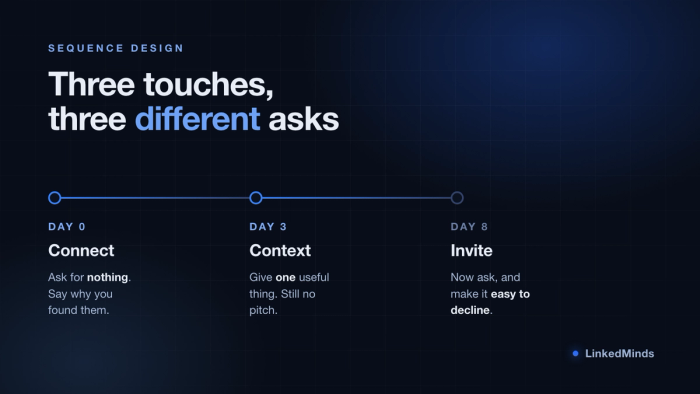
Ask for the connection. That is all. There are two more messages coming and both of them are better places for the actual request.
Four: the perfect paragraph#
Three clauses, balanced structure, no contractions, not a single wasted word. Real people write worse than this. Polish past a certain point reads as generated, because increasingly it is.
Short sentences. A contraction. One fragment. That is what a busy human writing quickly actually produces.
The shape that works#
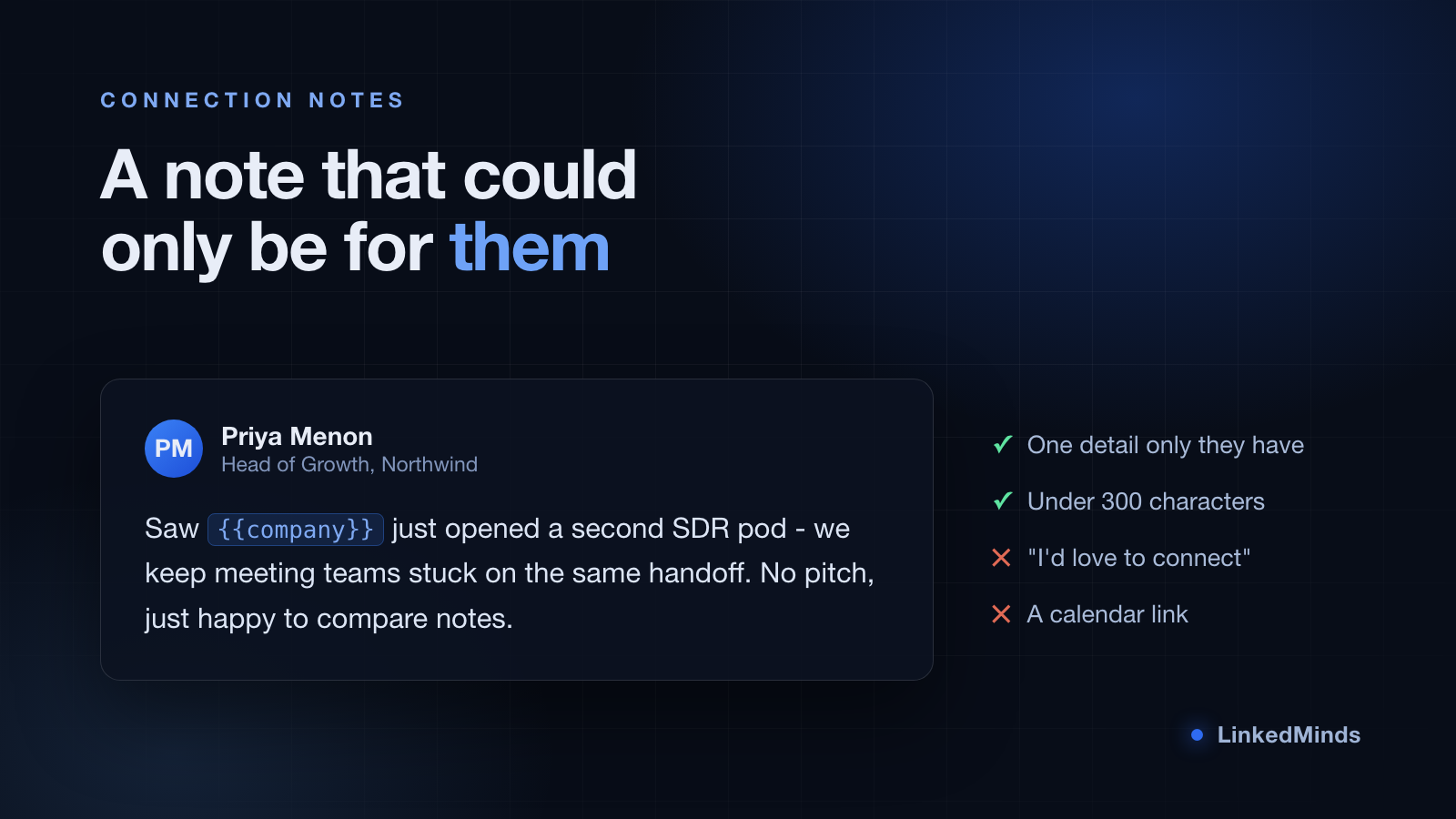
Almost every good note we have seen has the same three parts, in this order, in under 200 characters:
- The specific thing. One clause naming something real about them or their company.
- Why that means you. One clause connecting it to your world, honestly.
- A plain ask to connect. No hook, no calendar link, no cliffhanger.
Example:
Saw you took over demand gen at Northwind in the spring. We are two years into the same shift on a smaller team and getting most of it wrong. Would like to follow along, mind connecting?
It is specific, it admits something, it asks for nothing. It also looks like it was typed by a person, because that shape is quite hard to mass produce, which is precisely why it works.
The test#
Read your note and ask a single question: could this exact text be sent to anyone else on my list?
If yes, it is a template with variables and it will be read as one. If genuinely no, you have written a note that will be answered, and you have also proved that the person belongs on the list at all.
That second part is the real value. The discipline of writing a specific note is also the fastest way to find out that half your list should not be in the campaign.