One LinkedIn account is a personal workflow. Ten is an operations problem, and the failure modes are completely different. This is how multi account outreach is structured in LinkedMinds and, more importantly, why.
Every account is genuinely separate#
The most consequential design decision is one you never see. Each connected account gets its own browser context and its own residential proxy in its own region. They are not tabs in a shared browser. They do not share cookies, storage or fingerprint.
The reason is blunt: LinkedIn is good at linking accounts that share infrastructure. Two accounts appearing from the same address with the same fingerprint are two accounts that can be actioned together. Isolation means one restricted account is one restricted account.
The proxy matching the account's real geography is part of the same idea. An account whose owner lives in Bangalore should not suddenly be acting from Frankfurt. That single mismatch is one of the most reliable ways we have seen to trigger a checkpoint.
Limits are per account, always#
There is no team wide send budget, and this catches people out. Ten accounts do not share a pool of 300 invites. Each has its own daily limit, its own pacing, its own risk score and its own warm up state.
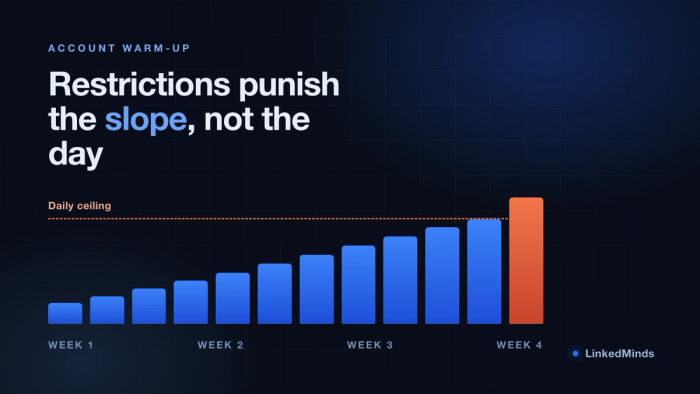
A new hire's account on day three is doing five invites a day while a two year old account beside it does sixty. Pooling them would drag the mature accounts down and, far worse, push the new one straight into a restriction.
The problem you will actually hit: crossed wires#
The genuinely hard part of multi account outreach is not sending. It is making sure the right account talks to the right person.
The specific disaster is a lead who gets a connection request from one colleague and a follow up from another, or a reply that lands in the wrong person's inbox. It reads as either incompetent or deceptive, and there is no recovering the thread.
Three things prevent it:
- A lead belongs to one account for its whole lifetime. The account that sent the invite is the account that follows up, always.
- The inbox is account scoped. You see the conversations belonging to the account you are looking at, never a merged view that hides who said what.
- Enrichment uses the owning account. Even a profile view goes out from the account that owns the relationship, so the lead's activity history stays coherent.
What a team lead should actually watch#
Not the total send count. It looks impressive and tells you nothing. Four numbers, per account:
- Acceptance rate. Diverging rates across accounts means the lists differ in quality, not the people.
- Pending invite count. The clearest early warning available, and it needs watching per account because one person's backlog is invisible in a team average.
- Risk score. Anything elevated is a conversation this week, not next month.
- Reply rate. The only number that connects to revenue, and the one most likely to be quietly bad while everything else looks fine.
Averages across accounts hide exactly the account that is about to be restricted. Look at the spread, not the mean.
When someone leaves#
Their leads do not transfer, and this is not a missing feature. The relationships belong to a person, and moving a live conversation to a different sender is both obvious to the recipient and a good way to get reported.
What you do instead: let the account finish its live conversations, stop new sends, and start fresh lists on the accounts that remain. The pipeline that person built is not lost. It is just no longer something automation should be touching on their behalf.