Every account connected to LinkedMinds carries a risk score. When it rises, the platform reduces that account's pace on its own, without waiting to be told. This post is what sits behind that number.
We are describing it in the open for one reason: a safety feature you cannot inspect is indistinguishable from a marketing claim.
What the model is actually predicting#
Not "will this account be banned". Bans are rare, terminal and arrive with almost no observable warning, which makes them nearly useless as a training target.
What it predicts is the thing that does have warning signs and does precede most bad outcomes: will this account hit a restriction, a checkpoint or a hard verification prompt in the next several days. Those are frequent enough to learn from and early enough to be worth acting on.
The signals#
Volume relative to the account's own history#
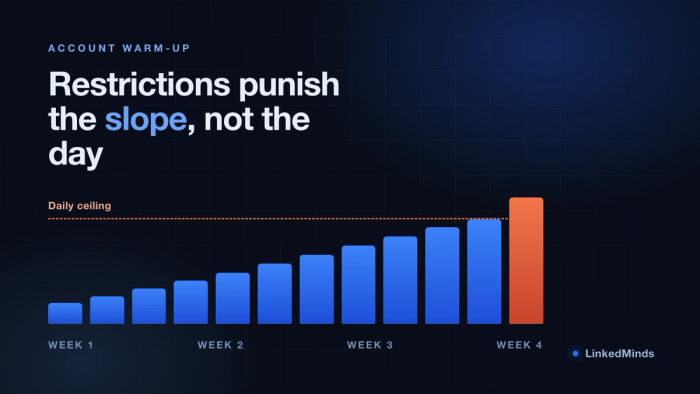
Absolute numbers matter far less than change. Forty invites is unremarkable for an account that sent thirty five yesterday and alarming for one that sent four. The features are almost all ratios against that account's own trailing baseline.
Pending invite ratio#
Outstanding invites divided by invites sent. This is the strongest single predictor we have found. An account with hundreds of unanswered invites is telling LinkedIn, in the clearest available terms, that it is contacting people who did not want to hear from it.
Acceptance rate trend#
Falling acceptance while volume holds is a targeting failure that is about to become a standing problem. The direction matters more than the level.
Action timing distribution#
How evenly spaced the actions are, and how much of the activity falls outside plausible working hours for the account's timezone. Regularity is a stronger automation signal than volume.
Friction events#
Checkpoints, unusual login location prompts, empty search results, capped result pages. Each of these is LinkedIn telling you something. The model treats them as the loudest inputs it has.
What it deliberately ignores#
Message content. The model never reads what you wrote.
Partly for privacy. Mostly because it does not help: in the data we have, the behavioural pattern around a message predicts the outcome far better than its wording does. A perfectly written note sent 200 times in an hour still ends badly.
What happens when the score rises#
Nothing dramatic, which is the point.
- Elevated: daily pace is reduced, gaps between actions widen.
- High: invites pause, low risk activity continues so the account does not go abruptly silent.
- Critical: all automated activity stops and you are notified with the specific signals that triggered it.
The steps are intentionally gradual. An account that is throttled for two days recovers completely. An account that is restricted may never fully recover, and no amount of subsequent good behaviour undoes it.
What it cannot do#
Honest limitations, because pretending otherwise would be worse than useless.
- It cannot see what LinkedIn sees. It infers from our side of the connection only.
- It cannot help with activity outside LinkedMinds. If you are also running another tool on the same account, the model is looking at half the picture and will be over confident.
- It cannot save an account that was already in trouble when you connected it.
- It will sometimes slow down an account that would have been fine. We consider that the correct direction to be wrong in.
A model that is occasionally too cautious costs you a few days of volume. A model that is occasionally too confident costs you the account.