The question we get most often is some version of "how many invites can I send per day". It is the wrong question, and answering it with a number is how people get restricted.
LinkedIn does not appear to enforce a single daily ceiling. It looks at a pattern: how your volume compares to your own history, how human the timing is, how many of your invites go unanswered, and how many people mark your messages as unwanted. A brand new account sending 20 invites is at more risk than an established one sending 60.
Start from where the account actually is#
Before any automation touches an account, three things need to be true, and none of them are optional.
- The profile is finished. Photo, headline, about section, at least a couple of roles. An empty profile sending invites is the single clearest automation signal there is.
- The account is identity verified. LinkedIn treats unverified accounts far more harshly under any kind of volume. We have watched unverified accounts get restricted almost immediately under load that a verified account absorbs without a flicker.
- There is some existing network. Fewer than about 50 connections and every invite you send is a larger proportion of your entire history, which is exactly the shape anomaly detection looks for.
The ramp#
The point of a warm up is not to be slow. It is to make each day look like a plausible continuation of the day before. Roughly:
- Week one: five to ten invites a day. Spend more time browsing, reacting and viewing profiles than inviting.
- Week two: ten to fifteen. Add a small amount of messaging to people who already accepted.
- Week three: fifteen to twenty five, if and only if acceptance is holding above about 30 percent.
- Week four onward: climb toward your steady state, adding no more than about five a day week over week.
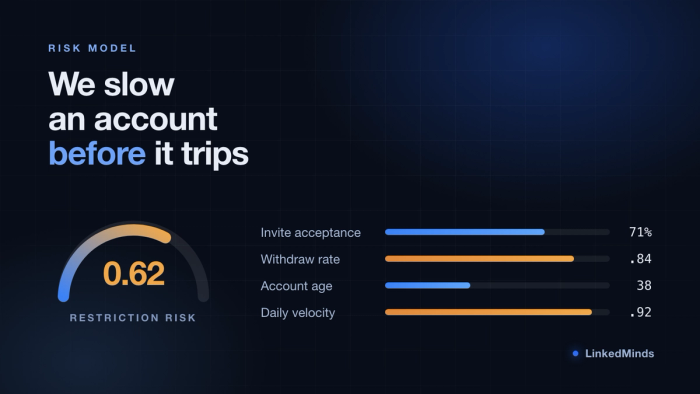
The condition matters more than the numbers. If acceptance rate falls while volume rises, you are not warming up, you are accumulating pending invites, and pending invites are the metric that most reliably precedes a restriction. Fix targeting, do not add volume.
The part nobody talks about: withdrawing#
Every invite that sits unanswered is a small ongoing cost to your account standing. People send 500 invites, get 100 accepts, and leave 400 pending forever.
Withdraw invites that have gone unanswered for more than about two weeks. Not all at once, and not immediately after sending, because withdrawing too soon after sending is its own odd signal. A steady trickle of withdrawals is what a normal user looks like.
Timing is a bigger signal than volume#
Twenty invites sent evenly across a working afternoon is unremarkable. The same twenty in four minutes at three in the morning local time is not, and no message quality will save you from it.
Three rules that cost nothing:
- Act only during working hours in the account's own timezone.
- Leave uneven gaps between actions. Perfectly regular intervals are the easiest possible thing to detect.
- Take weekends mostly off, or at least visibly lighter.
The signals that a restriction is coming#
Restrictions rarely arrive without warning. Watch for these and slow down when you see them:
- Acceptance rate falling week over week while volume is flat or rising.
- A sudden checkpoint, phone verification or new location prompt on login.
- Search results going empty or capped much earlier than usual.
- The invite dialog quietly offering fewer options than it did last week.
Any one of these is a reason to cut volume by half for a week. All of them together is a reason to stop for several days. An account that pauses for a week recovers. An account that gets restricted may not.
A restricted account costs more than every reply it ever earned. Restraint is not the boring part of outreach. It is the whole game.